
The Optional Field That Broke Our Funnel

It's amazing how easily a "harmless" optional field can tank a funnel. We learned that the hard way.
We've all been there — tempted to add just a little more to a product release. Usually, it's an optional information field that isn't essential for completing the task, but we tell ourselves: "It's optional. If customers don't want to interact with it, they can skip it. What could go wrong?"
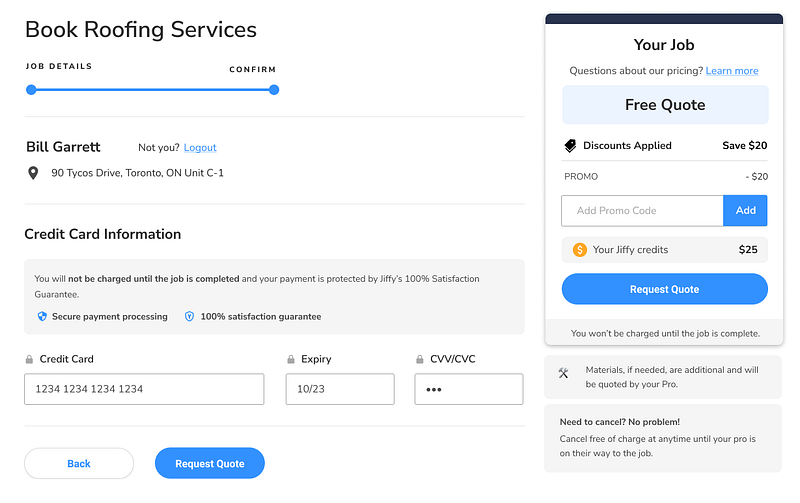
Well, it did for us. We introduced an optional Credit Card field in our quoted job-booking flow, and it brought down our funnel conversion.
Luckily, we didn't add this field across all platforms. While that was initially the plan, we somehow left it off our mobile apps — and got lucky, because that's where we caught the problem.
This post is a bit of a pie-in-the-face moment, but worth sharing. Product development isn't always straightforward, and sometimes good intentions lead to unexpected results. The point is: we all make these calls, and we can all learn from them.
The Background
At Jiffy, we offer two types of jobs you can book for your home:
- Set-rate jobs — services with a clear hourly or unit price, like Plumbing (by the hour) or Duct Cleaning (by vent).
- Quoted jobs — larger projects best handled with an upfront quote and a fixed price agreed upon by the homeowner and service professional (think Roofing or Painting).
When a homeowner requests a quoted job, they can receive multiple free quotes — no upfront payment or commitment required, beyond creating a Jiffy account. If they decide to move forward with a quote and don't have a credit card on file, that's when we ask for one before confirming the job.
For new customers, there's no reason to ask for a credit card before they've even seen any quotes. The only advantage of collecting it early is convenience — one less step later when they accept a quote.
That was our logic at the time: add a Credit Card field as an optional step during the quoted job booking flow. Those who wanted to provide it could do so; everyone else could skip it.
We were wrong. And our fortunate omission in the mobile app helped us see why.
Diagnosing the Problem
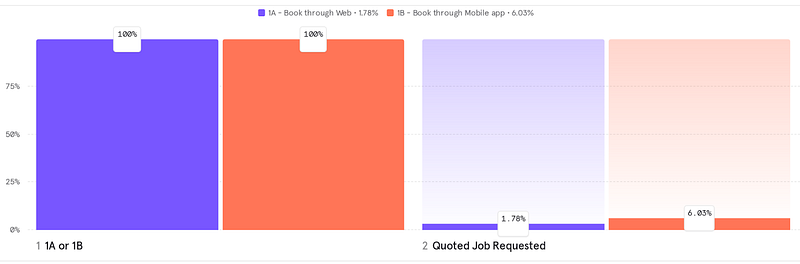
We found the issue by comparing the quoted job request funnel on web vs. mobile. The difference was stark — web conversions were noticeably lower.
Digging deeper, we saw the sharpest drop at the final step of the flow, where first-time customers reviewed their booking details. On the web, they saw the optional Credit Card field; in the mobile app, they didn't.
That one field was enough to cause hesitation — and drop-offs.
Session Recordings Told the Story
Tools like Hotjar (for web) and Smartlook (for mobile) helped us see what was happening. Watching session recordings, we could see users hesitate and hover around the Credit Card field.
It's fascinating how mouse movements often mirror what people are thinking — and in our case, those movements revealed uncertainty. Users circled the field, clicked around it, and lingered before abandoning the flow entirely.
Lessons Learned
We assumed "optional" would be clear. It wasn't.
Many customers thought the field was mandatory, and since they were only requesting a free quote, being asked for a credit card didn't sit right. Some simply dropped off.
We agreed with them: a free quote shouldn't require a credit card. Our mistake was assuming people would intuitively skip over an optional field.
The fix was a simple and subtractive one. We removed the optional Credit Card field and saw the conversion funnel recover. Within a month, web and mobile conversion rates were back in sync.
A Note on Feature Flags, A/B Tests, and Validation
Could we have caught this earlier with feature flags or A/B testing? Maybe. But this was part of a full redesign of the booking flow, so isolating the impact of one element wasn't practical.
We had just refreshed the site's front page and wanted the booking experience to match. Along the way, we tried to improve the flow with what we thought were best practices — and that's where this "optional" field snuck in.
Realistically, how granular can you get with feature flags or experiments? If you have a big roadmap, there's often little time or bandwidth to test every small variation.
This wasn't our first time offering quoted jobs online, but the redesign was different enough that comparing to older performance data wouldn't have told us much. There were too many moving parts.
In the end, we shipped what we believed was a better experience — and our users taught us otherwise. If not for the accidental omission in mobile, session recordings would have eventually led us to the same conclusion — at least that's what I tell myself.
On Usability Testing
Could usability testing have caught this? Possibly — but only if we'd shown the prototype to new users. Existing customers already had cards on file, so they wouldn't have experienced that hesitation.
Targeting new users for tests isn't trivial, and hired testers or friends and family rarely reflect real behaviour. It's something we're still trying to improve.
In the End
This experience reminded us that every additional field, even an "optional" one, adds friction — and every bit of friction is a potential leak in your funnel.
In product design, subtraction is often the most powerful form of improvement, and something worth keeping in mind when you're tempted to add that "optional" element.